Circle Skirt Yardage Calculator: The Math Behind Full, 3/4, and Half Circles
Circle skirts look simple until you try to buy fabric for one. Here's the radius math that gets you the right yardage the first time — plus a free calculator that does it for you.
Why circle skirts are deceptively hard to estimate
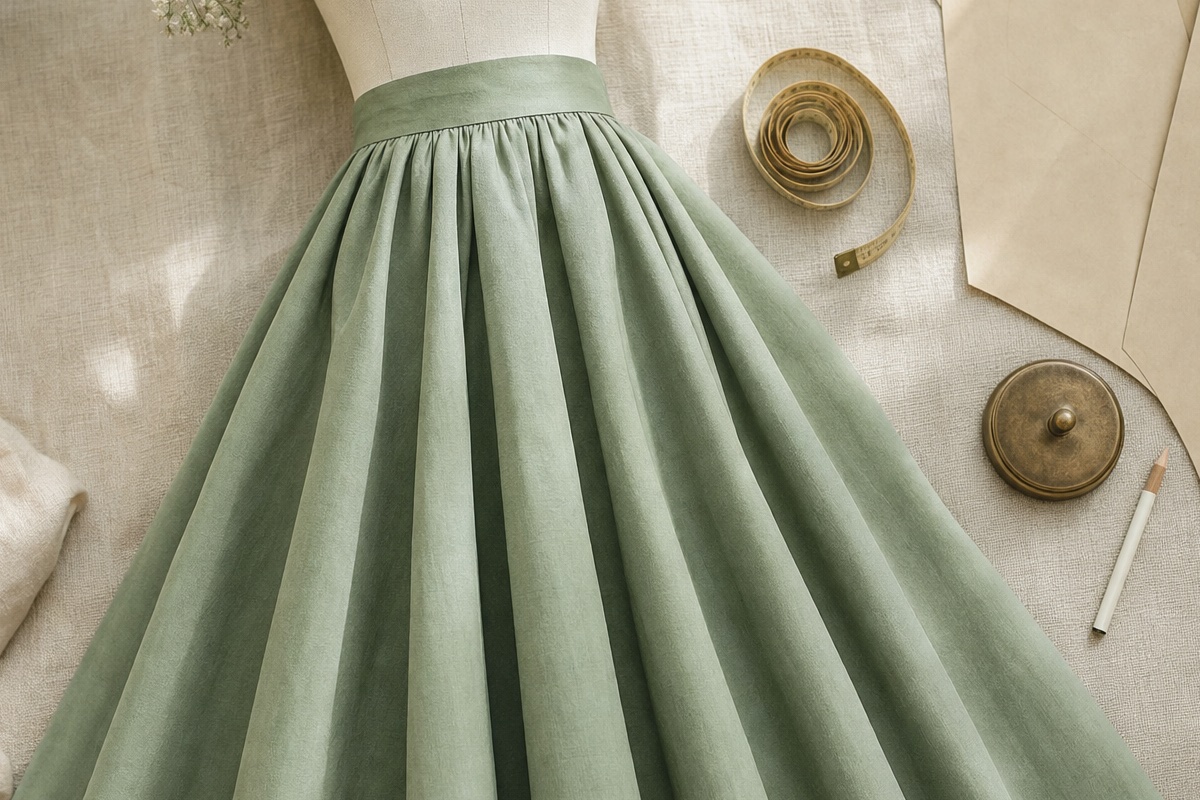
A circle skirt looks like the simplest garment in sewing — no darts, no fitted seams, just a dramatic swish of fabric. But estimating yardage for one trips up even experienced sewists, because the skirt isn't a rectangle or even a simple cone. It's a flat ring (an annulus, if you want the geometry term): a hole in the middle sized to your waist, and an outer edge sized to your hem.
That ring shape is why "just buy 3 yards" advice is so often wrong. A full circle skirt for a 26-inch waist and a 20-inch length needs a very different cut than the same skirt at a 36-inch waist, and the fabric width you're buying changes the answer again.
The actual formula
Every circle skirt calculation comes down to two radii:
Inner radius = (waist measurement + seam allowance) ÷ (2π × fullness fraction)
Outer radius = inner radius + skirt length + hem allowance
The fullness fraction is what turns a full circle into a half or three-quarter circle:
- Full circle = 1 (the entire 360° disc)
- Three-quarter circle = 0.75
- Half circle = 0.5
A smaller fullness fraction means a larger inner radius for the same waist — because you're asking a smaller arc of the circle to cover the same waist measurement, so that arc has to be further from the center.
Worked example
Say you want a full circle skirt, 30-inch waist, 25-inch length, 5/8-inch seam allowance, 1-inch hem:
1. Inner radius = (30 + 0.625) ÷ (2π × 1) ≈ 4.88 inches
2. Outer radius = 4.88 + 25 + 1 = 30.88 inches
3. Diameter = 61.76 inches
That diameter is the number that decides your yardage. On 60-inch-wide fabric, a 61.76-inch diameter just barely doesn't fit in one layer — you'd need to go to 72-inch fabric, or cut the skirt as two half-circles seamed at the sides (which roughly doubles the fabric length required, since now you need two lengths of the fabric's width instead of one square).
Switch to a three-quarter circle at the same waist and length, and the inner radius grows to about 6.5 inches while the diameter shrinks slightly — because a 3/4 circle only has to arc 270°, it can afford a bigger hole for the same waist opening without the outer edge growing as fast. Half circle skirts shrink the diameter further still, which is exactly why they're the fabric-frugal choice for wide hips-to-hem ratios.
Why fabric width matters more than yardage alone
Two cuts that are both "3 yards" can be completely different shapes of fabric. If your circle's diameter fits inside your fabric's width, you cut it as one piece from a single length — efficient, no side seams. If the diameter exceeds the width, you're cutting two half-circles and seaming them at the sides, which typically doubles the length of fabric you need even though the total skirt area doesn't change.
This is the single most common reason circle skirt sewists either run short or way over-buy: they picked a yardage number without checking whether their fabric width could fit the diameter in one layer.
Run the numbers yourself
The free Circle Skirt Yardage Calculator does all of this instantly — enter your waist, desired length, seam and hem allowances, fabric width, and fullness, and it returns the inner radius, outer radius, exact yardage, and tells you whether your fabric fits in one layer or needs piecing.
It's useful even if you've sewn a dozen circle skirts, because the one-layer-vs-two-layer threshold shifts with every combination of waist, length, and fabric width — it's not a fixed rule of thumb you can memorize.
Common circle skirt questions
Do petticoats or crinolines change the yardage math? No — the calculator is for the skirt fabric itself. A petticoat underneath is a separate pattern and doesn't change your outer fabric's cut.
What if my waist isn't elastic — do I still use "waist measurement"? For a fitted waistband, use your actual waist measurement plus ease (usually 0–1 inch) in place of the raw number. For an elastic waistband, use a number partway between your waist and hip so the skirt pulls on comfortably — many patterns use the hip measurement directly for elastic waists.
Can I make a circle skirt longer than my fabric's width allows for one piece? Yes — this is normal for maxi-length circle skirts. You'll almost always need to piece a maxi circle skirt from two or more panels regardless of waist size, because the outer diameter grows with length.
Does fullness fraction affect how "twirly" the skirt is? Yes. Full circle gives the most dramatic flare and the most fabric use; half circle drapes closer to the body with far less bulk at the waist — useful for curvier figures or when you want less volume.
Track your circle skirt cuts in Sewist Studio
Once you've calculated your yardage, log the project in Sewist Studio with the exact cut dimensions, fabric used, and any fit notes. Next time you want another circle skirt in a different fabric, you're not re-deriving the math — you already have the radius numbers on file, and your digital fabric stash tells you instantly whether you have enough fabric on hand before you buy more.