Heirloom Embroidery Stitches: Bullion, Satin, Shadow Work, and French Knots
You only need a handful of stitches to embroider an heirloom gown. Here's how each one works and where to use it.
A small vocabulary
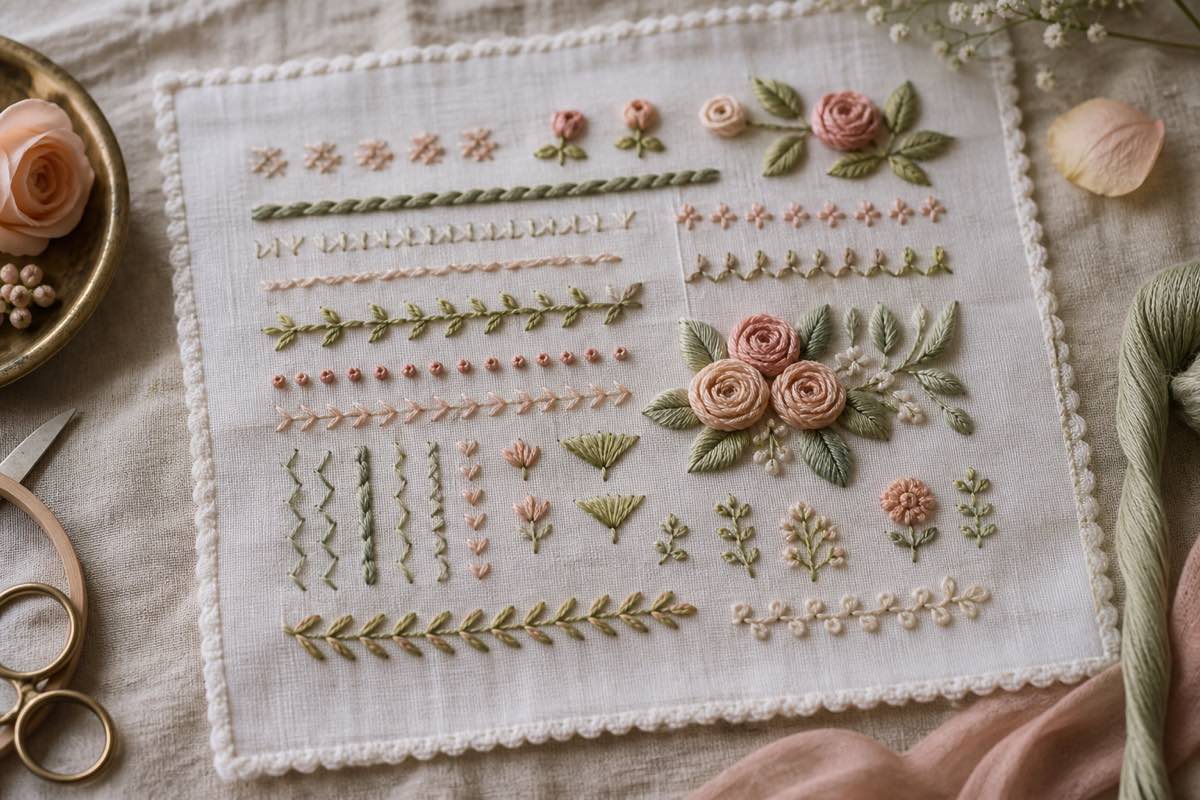
Heirloom embroidery does not use hundreds of stitches. Four or five carry almost every design.
Bullion knot
The signature stitch. A bullion is a long twisted coil of floss laid on the fabric surface, used to make tiny roses, buds, and initials.
Technique:
1. Bring needle up at point A, take a stitch to point B, but do not pull through.
2. Wrap the floss around the needle 6–10 times.
3. Hold the wraps between thumb and finger, pull needle through slowly.
4. Rock the coil into place and take needle down at B.
Use a milliner's (straw) needle — the shank is the same width as the eye, so wraps slide off smoothly.
Satin stitch
Parallel straight stitches worked closely to fill a shape. Used for leaves, hearts, initials, and picture-smocking motifs.
Keep stitches at the same angle across the shape and pack them so no fabric shows through. On curved shapes, split into wedges and let the angle rotate slowly.
Shadow work
Herringbone stitch worked on the wrong side of transparent batiste. The floss shows through as a soft tinted shape with outlined edges — hence "shadow." Traditionally used for delicate front-facing motifs like butterflies, hearts, or letters.
Use 1–2 strands of floss and mark the design on the right side lightly. Work carefully — corrections show through.
French knot
Small raised dot. Wrap floss 2–3 times around the needle, insert needle back into the fabric next to where you came up, hold the wraps as you pull through.
Use for:
- Flower centers
- Eyes on animal motifs
- Sprinkled dots between larger stitches
Chain, stem, and outline
Support stitches used to outline shapes and connect motifs. Not glamorous, but the reason a bullion rose reads as a rose is the tiny stem-stitched stem beside it.
Thread and needle chart
| Stitch | Strands | Needle |
|---|---|---|
| Bullion knot | 3 strands DMC | Size 10 milliner's |
| Satin stitch | 2–3 strands DMC | Size 9 crewel |
| Shadow work | 1–2 strands DMC | Size 10 sharps |
| French knot | 2–3 strands DMC | Size 9 crewel |
Practice as a sampler, then commit
Every heirloom sewist keeps a scrap sampler of bullions and satin leaves in current floss colors. It's your reference and your quality control — if the sampler looks right, the garment will.
Track your embroidery library
Every finished heirloom piece is a color and stitch recipe worth keeping. Save each one to Sewist Studio's camera cataloging with floss list attached, and use the digital stash so you can see which DMC numbers you actually own before starting a new commission.