Sewing Machine Maintenance: A Checklist for Keeping Your Machine Happy
A skipped stitch or nesting thread usually isn't a broken machine — it's a maintenance issue. Here's the daily, weekly, and yearly checklist that keeps every machine in your studio running.
TL;DR. 90% of "my machine is broken" moments are dirty bobbin areas, dull needles, or lint in the tension discs. Brush after every project, change the needle every 8 sewing hours, deep-clean every 3 months, and book a professional service once a year. Sewist Studio's Machine Tracker keeps a maintenance log per machine so you never have to remember when your serger was last serviced.
Your machine isn't broken. It's hungry.
Most sewists call a repair shop at least once over a problem the repair tech solves in 90 seconds with a brush and a screwdriver. Skipped stitches, thread nesting on the underside of seams, tension that won't balance, weird clunky noises in the bobbin area — these are almost always maintenance issues, not failures.
Modern home sewing machines are mechanical instruments running thousands of cycles per minute. Lint, dull needles, old oil residue, and dust on the tension discs accumulate faster than you'd think. The good news: routine maintenance is fast, cheap, and adds years to a machine you might otherwise replace.
Daily / per-project maintenance (5 minutes)
Do this every time you finish a project, or after every 8–10 hours of sewing.
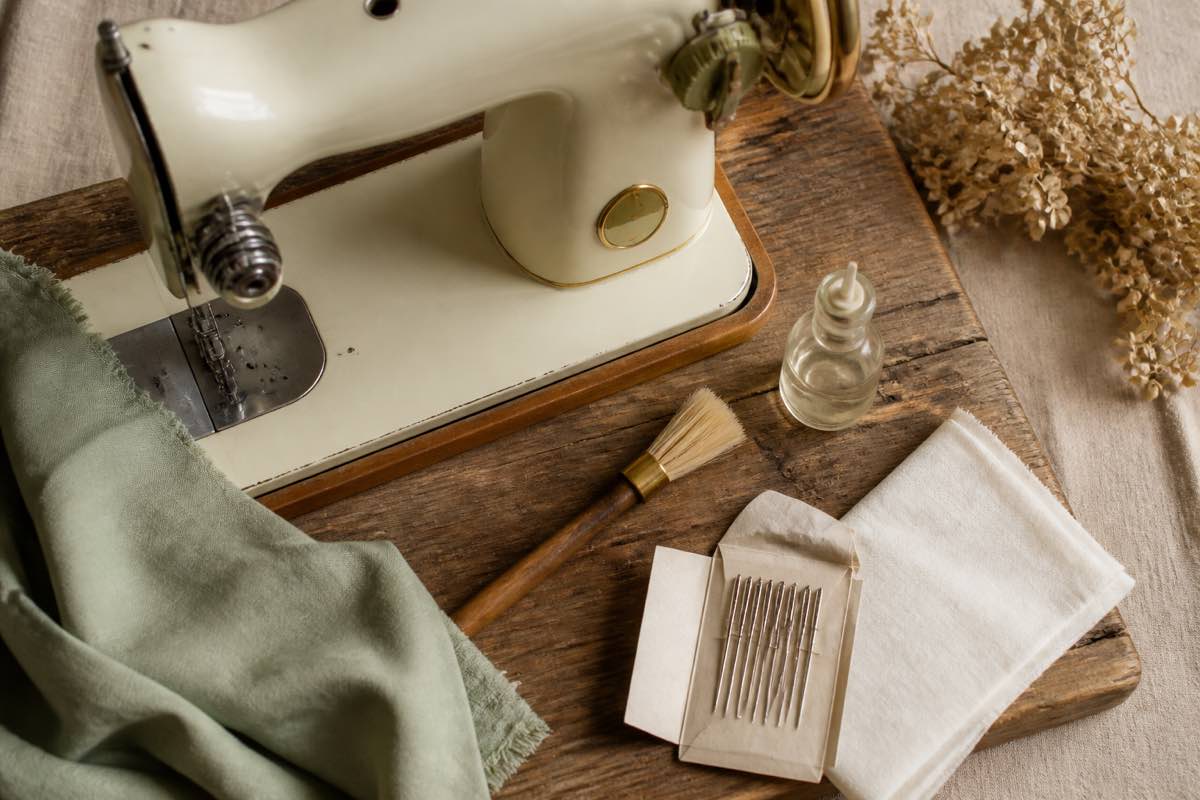
- Brush out the bobbin area. Remove the bobbin and bobbin case. Use the small brush that came with the machine (or a soft makeup brush) to clear lint from the race hook, feed dogs, and the slot where the bobbin sits. Never use canned air — it blows lint deeper into the machine.
- Wipe the throat plate. A microfiber cloth removes thread wax and lint residue.
- Check the needle. If it's been more than 8 hours of sewing or the project involved heavy fabric, change it.
- Loose-thread sweep. Check that no thread tails are wrapped around the spool pin, thread guides, or take-up lever.
That's it. Five minutes that prevent 80% of mid-project frustration.
Weekly / per-3-projects maintenance
- Wipe down the exterior with a soft, slightly damp cloth (no solvents).
- Clean the tension discs by passing a folded scrap of muslin between the discs with the presser foot up — lint that lives in the tension discs is invisible and causes mystery tension issues.
- Inspect the power cord and foot pedal cable for fraying.
Quarterly deep clean (15–20 minutes)
Every 3 months, or every 40 hours of sewing.
1. Unplug the machine.
2. Remove the bobbin, needle, and presser foot.
3. Remove the throat plate (one or two screws, depending on machine).
4. Brush every visible surface — race hook, feed dogs, bobbin case area, underside of the throat plate.
5. If your manual says to oil, place one drop of sewing machine oil (not 3-in-1, not WD-40) on the hook race. Run the machine for 30 seconds with a scrap of fabric to distribute and absorb excess.
6. Reassemble. Wind a new bobbin. Sew a 4-inch test seam on scrap fabric and check stitch quality on both sides.
Some computerized machines (most Bernina, many newer Janome and Brother) are self-lubricating and only need oil at professional service. Adding oil where it's not needed gums up the works. The manual is the authority. If you've lost the manual, search the model number — most manufacturers host PDFs free.
The 8-hour needle rule (this matters more than you think)
Sewing machine needles are consumables, like printer ink. They dull faster than you can see. A dull needle:
- Skips stitches
- Snags fine fabrics
- Snaps thread
- Pulls knit fabric instead of piercing it
- Makes a louder "thunk" with every stitch
Change the needle every 8 hours of sewing, every new project, or immediately after sewing denim, canvas, leather, or any fabric with a metallic or coated finish. Needles cost about $0.50 each. Frustration costs more.
Match the needle to the fabric:
| Needle type | Best for |
|---|---|
| Universal 70/10 | Light wovens (cotton lawn, silk) |
| Universal 80/12 | Mid-weight wovens (quilting cotton, linen) |
| Universal 90/14 | Bottomweight wovens (denim, canvas) |
| Stretch / Ballpoint 75 or 90 | Knits, jersey, lycra |
| Microtex / Sharps 80 | Fine cottons, silk, microfibers |
| Denim 90 or 100 | Denim, canvas, multiple layers |
| Topstitch 90 | Decorative topstitching with thicker thread |
| Leather 90 or 100 | Real leather and faux suede |
A drawer with at least Universal 80/12 + Stretch 75 + Denim 90 covers most projects without an emergency store run.
Yearly: professional service
Once a year for heavy users (8+ hours/week), every two years for occasional sewists. A professional tech will:
- Disassemble the machine and clean every internal surface
- Re-time the hook if needed
- Replace any worn parts (bobbin tension spring, race hook, drive belt)
- Re-oil internal moving parts
- Calibrate tension and stitch length
- Test all stitch patterns
Service runs $80–$150. On a $400 entry-level machine, that's expensive on paper. On a $3,000 computerized embroidery machine, it's a no-brainer. Either way, it doubles the practical lifespan of the machine and catches small issues before they become repair bills.
The Sewist Studio Machine Tracker
The hardest part of machine maintenance isn't doing it — it's remembering when you last did it, on which machine, with which needle, and what the service tech said.
Sewist Studio's Machine Tracker handles all of it:
- One profile per machine — main sewing machine, serger, coverstitch, embroidery machine, vintage hand-cranks. Each profile stores brand, model, year, manual link, serial number, and accessory list.
- Maintenance log — record every cleaning, needle change, oiling, and service visit with a date and notes. The full history is always one tap away.
- Reminders — set a needle reminder by hours of use and a service reminder by calendar interval. Notifications surface on your sewing room dashboard when something's overdue.
- Spec sheet — bobbin type, max stitch width, presser feet you own, recommended needle types. No more guessing which bobbin fits your serger at the store.
- Manual links — paste in the PDF URL of your manual and access it from any device.
If you own more than two machines, this alone is worth the free account.
A printable monthly checklist
Pin this near each machine.
- [ ] Bobbin area brushed (after every project)
- [ ] Needle changed (every 8 hours / new project)
- [ ] Tension discs flossed with muslin (weekly)
- [ ] Throat plate wiped down (weekly)
- [ ] Quarterly deep clean done (every 3 months)
- [ ] Manual oiling per manual instructions (quarterly, if applicable)
- [ ] Annual professional service booked (yearly)
Frequently asked questions
How often should I clean my sewing machine?
Brush lint after every project; deep clean every 3 months.
How often should I change my sewing machine needle?
Every 8 hours of sewing or at the start of every new project — sooner after heavy or abrasive fabric.
When should I take my sewing machine in for professional service?
Once a year for heavy users, every 2 years for casual users.
Do modern sewing machines need to be oiled?
Most self-lubricating machines don't between services; mechanical machines and sergers usually do. Check the manual.
How does Sewist Studio's Machine Tracker help?
Logs every machine, every maintenance event, and reminds you when the next is due.