Where to Find Free Vintage Sewing Patterns: 12 Legal Archives
Free vintage patterns exist, but mostly as scanned books, drafting systems and museum patterns rather than ready-to-print PDFs. Here are 12 legal sources and how to use them.
What "free vintage pattern" usually means
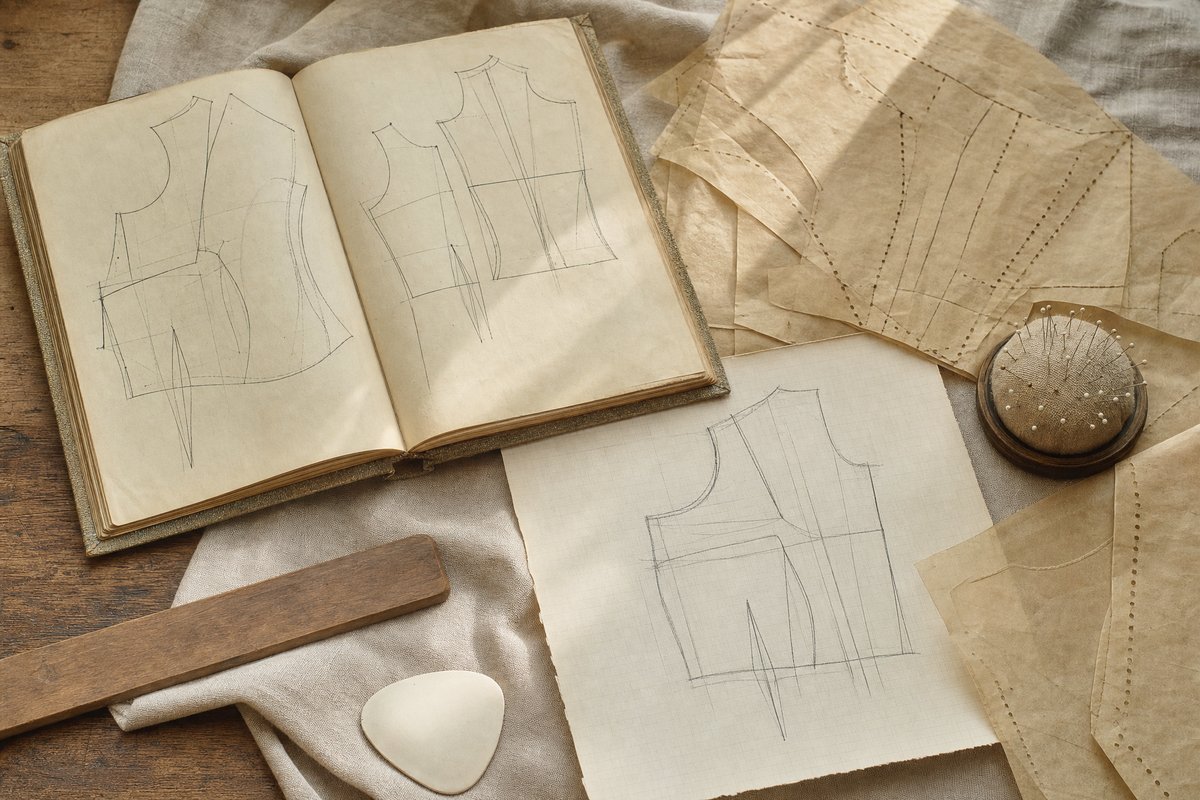
If you're hoping for a free, print-at-home PDF of a 1950s Butterick envelope, that mostly doesn't exist legally. What does exist, for free and in huge quantities, is older material: dressmaking manuals, pattern drafting systems, fashion magazines and museum garment patterns, much of it from before 1931 and in the public domain.
That's a different kind of resource. You'll usually draft or scale up a pattern rather than print and cut it. In return you get access to a century of construction knowledge that commercial patterns left out.
We checked every source below on October 4, 2026. (For collecting and storing original paper patterns, see our vintage sewing pattern collecting guide.)
Scanned dressmaking and drafting books
1. Internet Archive. About 1,000 texts tagged "dressmaking," free as PDF or EPUB. Good starting points are Butterick's The New Dressmaker (1921) and Conover's A Complete Course in Dressmaking (1922). Search results also include modern books that are borrow-only, so check the date and look for a download button. archive.org/details/newdressmakerwit00butt
2. Woman's Institute Pattern Drafting (1920). Mary Brooks Picken's 48-page guide to drafting a dress to your own measurements, marked public domain on the Internet Archive. One of the most practical free resources for drafting a vintage-style block. archive.org/details/patterdraftingpicken
3. Library of Congress. Thousands of digitized books turn up for "dressmaking," including Dressmaking in the Home (1923). The collection is described as public domain and free to reuse. loc.gov/books/?q=dressmaking
4. Project Gutenberg. A smaller set of relevant titles, all marked public domain in the USA: The "Keystone" Jacket and Dress Cutter (1895) with numbered drafting diagrams, and Talbot Hughes' Dress Design, which includes historical garment patterns. Download the "with images" version or the diagrams will be missing. gutenberg.org/ebooks/78496
Vintage fashion magazines
5. The Delineator on the Internet Archive. Butterick's own magazine, scanned by Cornell's Mann Library, with issues from about 1890 to 1935. Expect fashion plates and dressmaking articles rather than full-size patterns, but it is the best window into what home sewists were making. archive.org/details/delineator94oloua
6. Antique Pattern Library. Cleaned-up scans of craft publications from a Canadian nonprofit, free with no registration. Strongest for needlework, lace and knitting, with some fashion magazines such as La Mode Illustrée. The scans are licensed CC BY-NC-SA: free to use and share with credit, but not to sell. antiquepatternlibrary.org
Museum garment patterns
7. LACMA Pattern Project. 13 free PDFs drafted from real garments in the Los Angeles County Museum of Art collection, from about 1740 to 1942, including a 1790s redingote dress, an 1885 coat and a 1940s zoot suit. Each has a scaled pattern, photos and construction notes. You'll need to enlarge the pattern, and it fits the original wearer, so plan a toile. lacma.org/patternproject
8. American Duchess, Isabella MacTavish Fraser gown. A free ($0) gridded PDF of an 18th-century tartan wedding gown from the Inverness Museum, with instructions. This is a modern reconstruction, so it is copyrighted and not for resale, but free to use. americanduchess.com
Free reproduction freebies
9. Mrs. Depew Vintage free patterns. Three $0 items: a 1940s barbecue apron pattern, a printable French curve and a pattern inventory card. Modern and copyrighted, but free. mrsdepew.com
10. Wearing History blog. Occasional free historical patterns, mostly 1910s knit, crochet and trim patterns rather than sewing patterns. Worth following if you sew Edwardian. wearinghistoryblog.com
Research and identification tools
11. Commercial Pattern Archive (CoPA), University of Rhode Island. Over 55,000 images from about 61,000 commercial patterns dating from 1847, free with no account. It doesn't contain full patterns to download, but it is the best place to date a pattern or see the original envelope and pieces. copa.apps.uri.edu
12. Vintage Patterns Wiki. A community catalog of patterns at least 25 years old, browsable by decade, company and garment type. Mostly identification, with a few links to free giveaway patterns from old magazines. vintagepatterns.fandom.com
Is it legal to use free vintage patterns?
A quick, practical summary of US copyright (this isn't legal advice):
- Published before 1931: in the US public domain as of January 1, 2026, according to Cornell University Library's public domain chart.
- Published 1931 to 1963 with a copyright notice: public domain only if the copyright was not renewed. Many weren't, but you have to check.
- Published 1931 to 1977 with no notice: generally public domain.
- Scans can carry their own license. A public-domain book may be scanned and shared under a license like CC BY-NC-SA, as the Antique Pattern Library and some Cornell scans are.
- Modern reproductions are copyrighted, even when free. Treat them as personal-use patterns unless the designer says otherwise.
Cornell's chart is the most useful single reference: guides.library.cornell.edu/copyright/publicdomain.
How to use a vintage drafting diagram
1. Find the scale. Many diagrams are drawn on a grid where one square equals one inch, or use a proportional system based on bust measurement.
2. Draft it full size on pattern paper or gridded paper, then true the seams.
3. Check seam allowances. Most early patterns include none. Add your own.
4. Compare to your body. Vintage patterns were drafted for corseted or differently proportioned figures and older sizing. A 1920s "size 36" is not a modern 36. See what size sewing pattern to cut.
5. Make a toile in cheap fabric before cutting anything good.
Keep your archive organized
Once you start pulling PDFs from four or five archives, it gets hard to remember which book had that 1920s sleeve. Sewist Studio lets you add each pattern or scanned book to one library and tag it by era, source and garment type, so you can sort your collection by brand and era. For modern free patterns, see where to find free sewing patterns.