Collecting Vintage Sewing Patterns: A Complete Guide
The eras, brands, condition grades, and cataloging system every vintage pattern collector needs.
Why collect vintage patterns
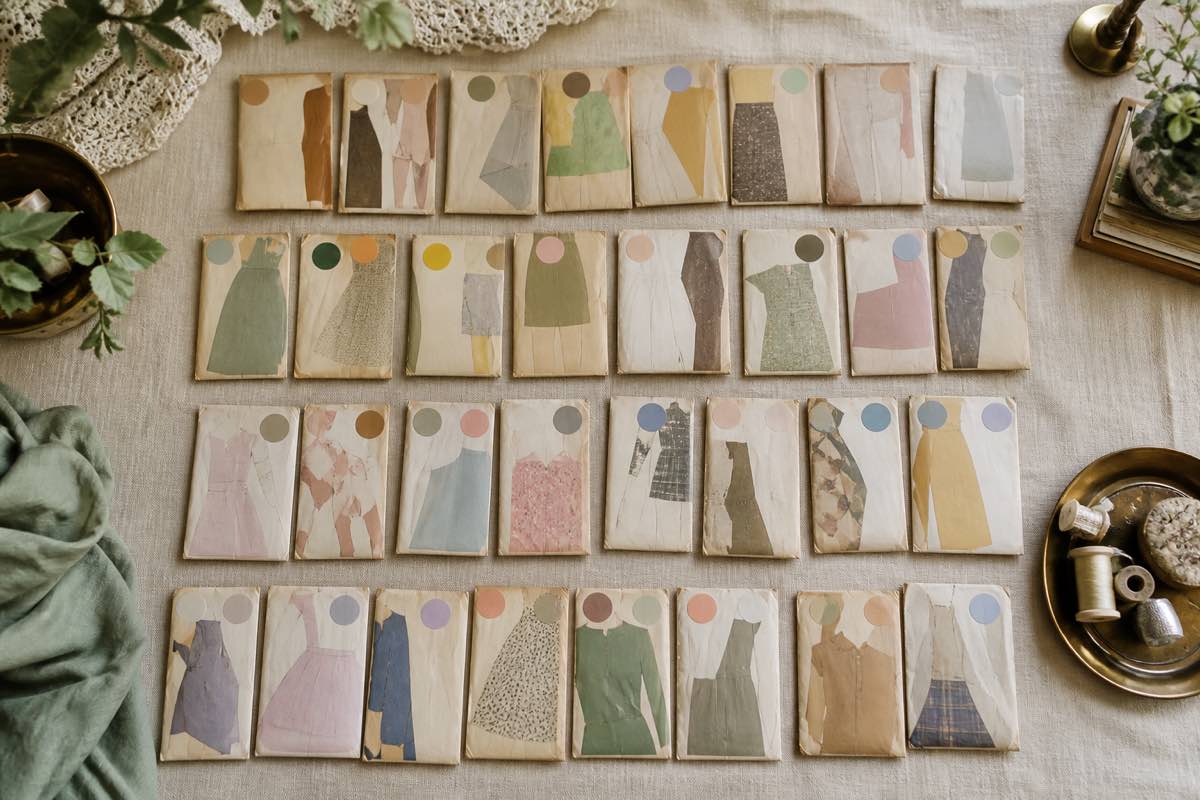
Vintage patterns are wearable history — bias-cut 1930s gowns, 1950s New Look silhouettes, 1970s wrap dresses. They're also a legitimate collectible with active resale markets.
Eras to know
- 1920s-30s — bias cutting, art deco, hardest to find
- 1940s — wartime restrictions, narrow silhouettes
- 1950s — New Look, full skirts, defined waists (most collected)
- 1960s — mod, shift dresses, designer names
- 1970s — wrap dresses, halterneck, folk influence
- 1980s — power shoulders, big cuts (most affordable)
- 1990s+ — early minimalism, becoming collectible now
Tag every pattern in your catalog with its era. Sewist Studio's pattern era filter is built for this.
Brands and value
Higher value:
- Vogue Paris Original / Vogue Couturier (designer names — Dior, Balmain, Cardin)
- Vogue Americana (US designers)
- Simplicity Designer
- Advance (defunct, harder to find)
Common:
- Butterick, McCall's, Simplicity standard lines
- Marian Martin, Anne Adams (mail-order)
Condition grading
Grade every pattern:
- A / Mint — factory folds, all pieces, envelope like-new
- B / Very Good — cut but complete, envelope clean
- C / Good — cut, complete, envelope worn
- D / Fair — pieces present but rough
- F / Incomplete — missing pieces
Log condition in the catalog. Missing-piece patterns can still be usable if the missing piece is common (belt, tie, facing).
Where to buy
- Estate sales (best prices, best finds)
- Etsy vintage-pattern sellers
- eBay
- Vintage sewing pattern groups on Facebook
- Local vintage shops
What to pay
Rough guide (US market, 2026):
- 1980s common: $3-$10
- 1970s common: $8-$20
- 1960s common: $15-$40
- 1950s common: $20-$60
- 1950s Vogue Couturier: $75-$250
- 1930s bias: $50-$400+
- Any 1930s Vogue Paris Original: $200-$1000+
Cataloging vintage differently
Vintage collections benefit from extra fields:
- Era / decade
- Original price (printed on envelope)
- Condition grade
- Country of origin (UK, US, France)
- Notes on missing pieces or repairs
Sewist Studio supports custom notes so you can capture all of this. Start your vintage catalog free.
Storage for vintage
Vintage envelopes are fragile:
- Acid-free comic-book bags (Mylar or polypropylene)
- Store flat, not upright, if possible
- Cool, dry, dark
- No rubber bands (they bleed onto paper over time)
Redrafting for modern bodies
Vintage patterns run small by modern standards. Expect a vintage "size 14" to fit a modern size 8-10 bust. Always compare finished measurements to your body before cutting.