The Right Needles for Smocking (and Pleaters Too)
The right needle disappears into the work. Here's how to match crewel, milliner's, and pleater needles to your fabric and stitches.
Why needle choice matters
Smocking sits on top of narrow pleats, so a slightly wrong needle either splits pleats, drags floss unevenly, or leaves visible holes. The right needle glides through cleanly and disappears into the work.
Crewel needles for hand smocking
Crewel needles (also called "embroidery needles") have a sharp point and a long eye that easily accepts multiple strands of floss.
| Needle size | Use with |
|---|---|
| #7 crewel | 3 strands of DMC on batiste, broadcloth, gingham |
| #8 crewel | 2 strands on very fine batiste or lawn |
| #6 crewel | 4 strands on heavier cottons |
A #7 crewel is the single most useful needle to own. Buy a variety pack the first time so you can feel the difference between sizes.
Milliner's needles for bullion knots
Milliner's needles (also called "straw needles") have a shaft that's the same width as the eye — critical for pulling wrapped bullion knots through cleanly.
- #9 or #10 milliner's for bullion rosebuds and picture smocking accents
If you smock roses with a crewel needle, the eye catches on the wraps and the knot pulls tight instead of sliding off smoothly. It's a night-and-day difference.
Pleater needles
Pleater needles are curved, machine-specific, and sold by the row. Read pleater needles fit Read machines only, Amanda Jane fits Amanda Jane, and so on.
Rules of thumb:
- Only pleat lightweight, on-grain fabric. Heavy or off-grain fabric bends needles.
- Replace bent needles immediately. One bent needle throws off the entire row.
- Keep at least a full set of spares. They're cheap individually but frustrating to source overnight.
Care and storage
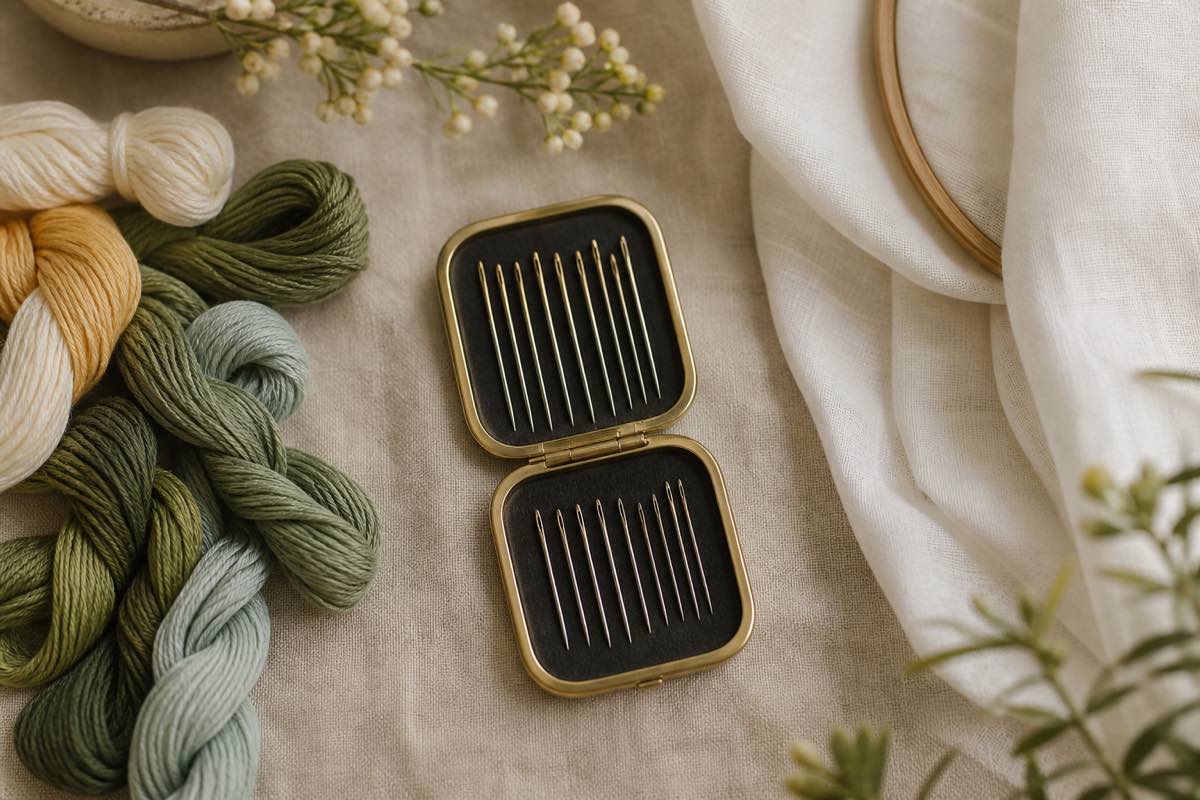
- Store hand needles in a magnetic case or needle book — never loose in a tin.
- Wipe with a soft cloth after each session to remove floss fibers and skin oils.
- Discard any needle that snags fabric or bends. A dulled needle is not worth saving.
Track needles in your studio
Needles are the easiest supply to lose track of. Tag needle sizes to your notions in the digital stash so you know exactly which crewel and milliner's sizes are on hand — and pair them with the machine needles you track in the embroidery workspace before you start a plate.
Add your needles and notions to Sewist Studio and stop hunting mid-project.
Quick shopping list for a new smocker
- 1 pack DMC crewel needles, sizes 5–10 (variety)
- 1 pack milliner's needles, sizes 8–10
- Magnetic needle case
- If you have a pleater: 1 full spare needle set for your model
That's a lifetime's worth for under $25.