The Smocking Stitch Library: Every Stitch a Smocker Should Know
The full smocking stitch vocabulary in one place — with the texture each stitch creates, when to use it, and how they combine into classic plates.
Why a stitch library matters
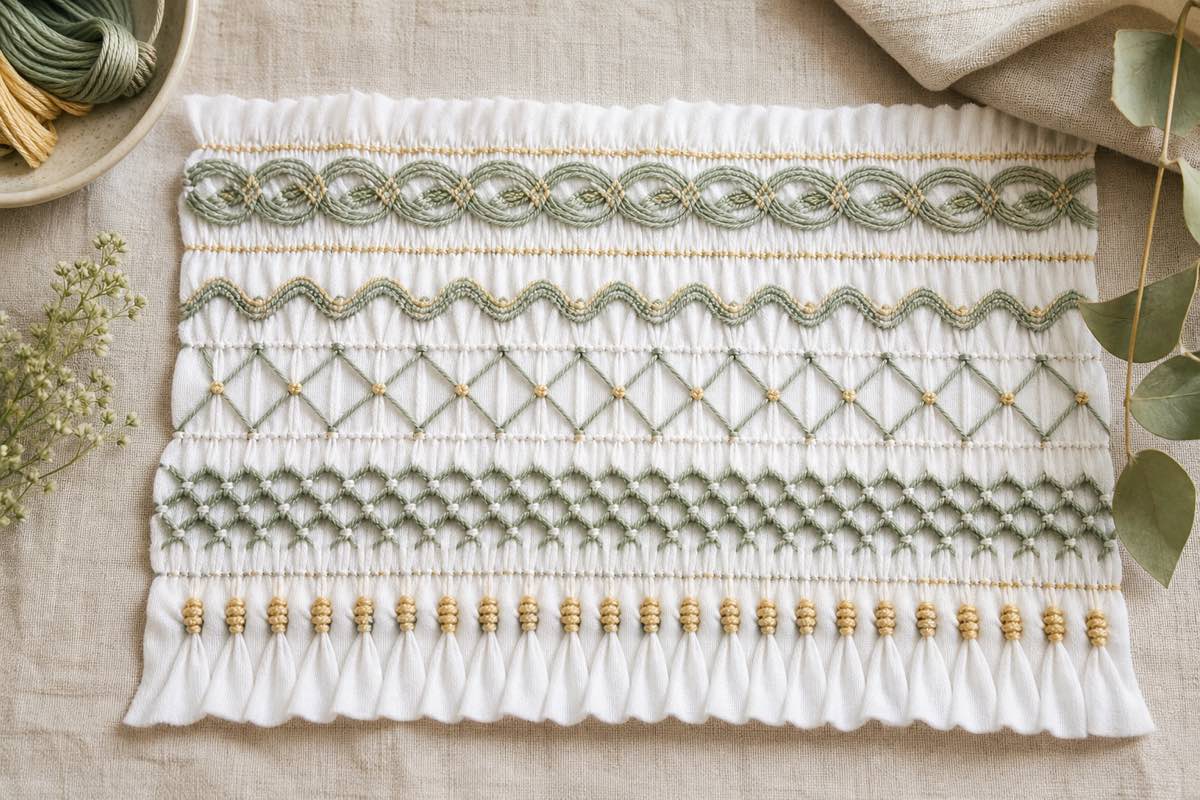
Every smocking plate — no matter how ornate — is built from a small set of foundation stitches. Once you know the library, you can read any design at a glance and start improvising your own.
The foundation stitches
Cable stitch
The workhorse. A tight horizontal row that locks pleats and anchors the top and bottom of a design. Worked as cable up (thread below the needle) and cable down (thread above), alternating.
Use for: top and bottom borders, dense bands of color.
Wave stitch
A cable that climbs up or down between rows, creating a zigzag. Two mirrored waves form a diamond. Wave depth is measured in "steps" — a two-step wave spans two half-rows.
Use for: diamond fields, trellis backgrounds.
Trellis
A wave stretched over more rows and steps. A four-step trellis forms tall, elegant diamonds.
Use for: open geometric fields, large plates.
Honeycomb stitch
Pulls two pleats together, drops down, and pulls the next pair — creating puffy hexagonal cells. Very stretchy.
Use for: bodices, cuffs, anything that needs stretch.
Surface honeycomb
The honeycomb pattern worked on the surface without pulling pleats together as tightly. Same look, less stretch.
Use for: decorative bodices where you want the honeycomb pattern but need to control the width.
Van dyke stitch
Worked from the wrong side, creating a knotted honeycomb effect with strong elasticity.
Use for: heirloom bodices, traditional English smocking.
Bullion knot
A wrapped knot used for rose centers, buds, and dimensional accents in picture smocking.
Use for: floral picture smocking, dimensional accents on geometric designs.
Stem and satin stitch
Borrowed from surface embroidery, used to outline motifs like leaves and stems in picture smocking.
Use for: adding flowers, animals, or scenery on a cable-anchored ground.
How stitches combine
Classic smocking designs layer these stitches in predictable patterns:
- Geometric plate: Cable border → wave rows → trellis center → wave rows → cable border.
- Picture smocking: Cable border → satin-stitched motif (rosebuds, bunnies, sailboats) → cable border.
- Bishop-style: Multiple rows of cable and wave, ending with a stretchy honeycomb section at the neckline.
Build your own stitch reference
Every smocker eventually needs a personal stitch reference — a photo library of every stitch worked in the flosses and fabrics you actually use. Sewist Studio's camera cataloging tags each sample by stitch, floss color, and fabric, and cross-links to the embroidery workspace so machine and hand stitches live in one library.
Save your first smocking samples and browse the full Smocking & Stitching Encyclopedia for step-by-step diagrams of every stitch above.