Smocking Plate Symbols Cheat Sheet: Reading Any Chart Fast
The universal smocking plate symbol key — dots, arrows, cables, waves — bookmark this for every smocking project.
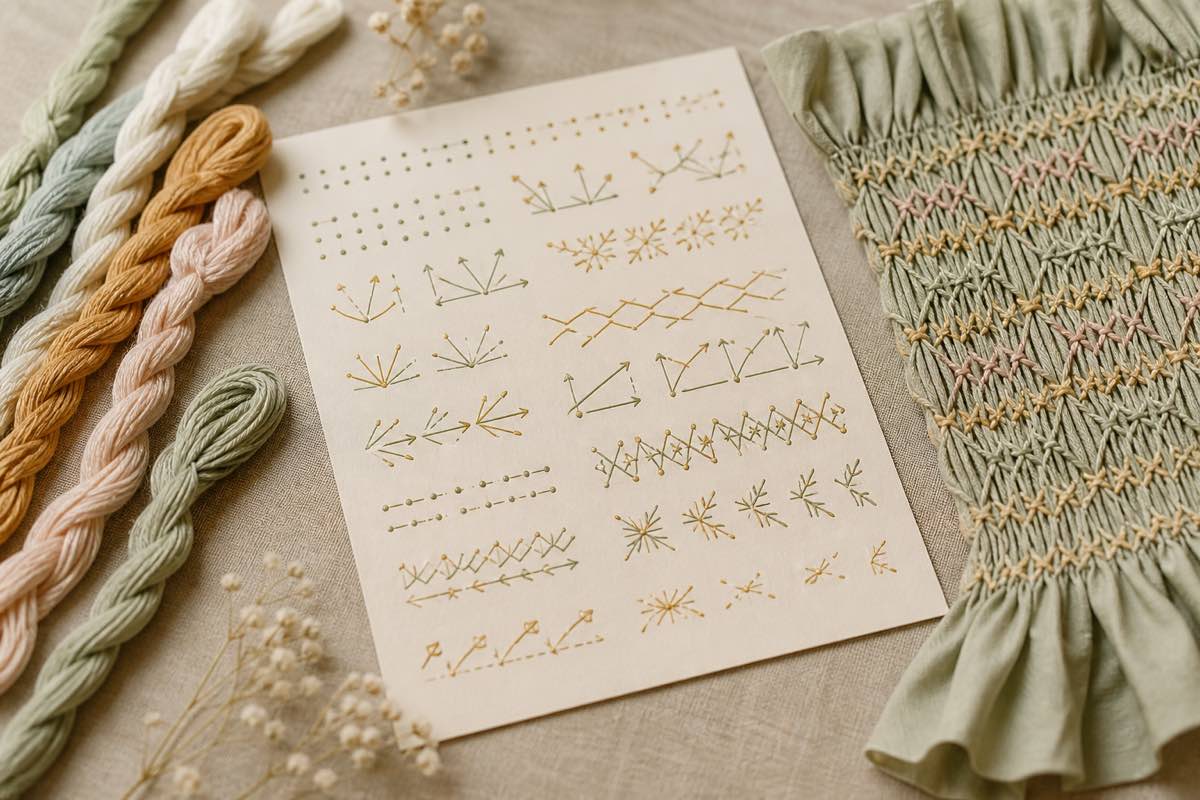
The universal symbol set
Every printed smocking plate — Australian Smocking & Embroidery, Sew Beautiful, Creative Needle, older Little Vintage Chic patterns — uses substantially the same symbols. Learn the set once and any plate becomes readable.
Core symbols
- Solid dot (•) — the thread pickup point on a pleat
- Number (1, 2, 3...) — the row number (top to bottom)
- Arrow (→) — stitch direction; usually left to right unless noted
- Vertical line — a pleat (pleat #1 leftmost, count rightward)
- Colored band — a distinct thread color; the key lists each color's DMC number
- Bracket or bar (⌐) — cable stitch, top or bottom
- Wavy line (~) — wave stitch, direction shown by wave curvature
- X or diagonal — trellis or diamond diagonal
- Diamond outline (◇) — honeycomb cell
- Circle or asterisk (○ / *) — a bullion or decorative accent
Row numbering
Rows run horizontally with row 1 at the top. Row half-numbers (1.5, 2.5) indicate stitches worked between pleater-marked rows — common in cable trellises.
Pleat numbering
Pleats run vertically, numbered 1, 2, 3… from left to right. "Cable across pleats 3-4" means one cable spanning pleat 3 to pleat 4.
Cable stitch notation
- Over-cable (top cable) — bracket opening downward: ⌐
- Under-cable (bottom cable) — bracket opening upward: ⌐ (flipped)
- Alternating over/under → a straight cable row
Wave stitch notation
- Up-wave — curve rising left-to-right
- Down-wave — curve falling left-to-right
- A single "chevron" is one wave up followed by one wave down
Trellis notation
Diagonal lines indicating diamond patterns:
- Two waves forming a diamond → "trellis diamond"
- Row of connected diamonds → "trellis row"
Honeycomb notation
Staggered diamond outlines. Because honeycomb collapses the fabric slightly more than cables, plates note the finished width shrinkage (e.g., "collapses to 65%").
Color bands and DMC keys
Most plates use two to five colors. The color key at the top or side lists each color's DMC (or Anchor/Madeira) number. Substitute colors freely, but match the value (light/medium/dark) or the pattern loses depth.
Reading a full plate — the 5-second scan
1. Note the pleat count and row count — sets the physical footprint.
2. Read the color key — know how many threads to prep.
3. Scan for the tallest element — a big picture-smocking motif tells you the visual anchor.
4. Identify repeat unit — most geometric plates have a 4-pleat or 8-pleat repeat.
5. Follow row 1 pleat-by-pleat — start where the pattern indicates (often the center).
Skip decoding entirely
Sewist Studio's AI smocking plate analyzer decodes any photographed plate into a step-by-step stitch guide. Especially useful for old plates with tiny or faded symbols.
Related reading
- How to read a smocking plate — the long-form guide
- Smocking stitch library
- Smocking for beginners