How to Sew Your First Garment with Online Sewing Help
A stage-by-stage walkthrough of a first elastic-waist skirt, with the questions worth asking a coach and the steps you simply do.
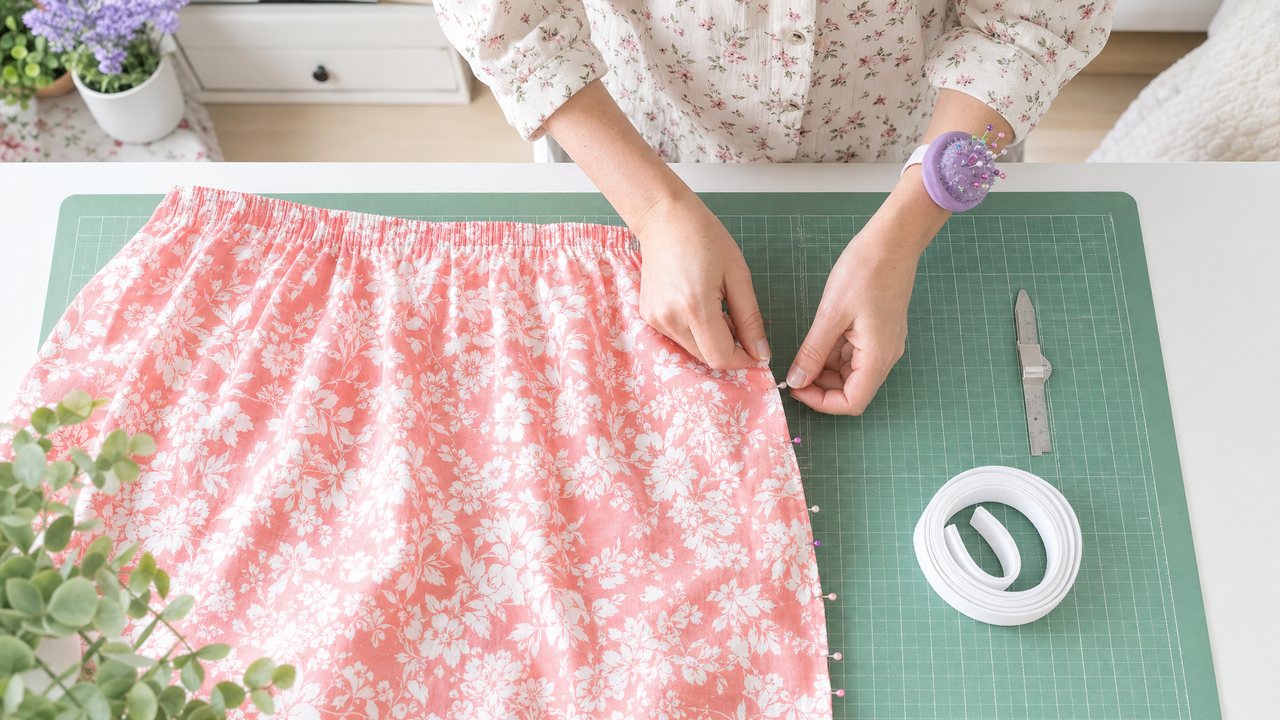
The easiest way to sew your first garment is to pick a simple pattern, like an elastic-waist skirt or a boxy tee, and work through it one stage at a time. Ask for help with the decisions. Do the physical steps yourself, slowly, on scraps first.
Online sewing help works well for beginners because most early mistakes are decisions, not skills: the wrong fabric, not enough yardage, skipping the pre-wash. This walkthrough uses an elastic-waist skirt as the example and shows, for each stage, what to ask a virtual sewing coach and what to just do.
What should a beginner sew first?
An elastic-waist skirt in a woven cotton is one of the easiest first garments. It has straight seams, no zipper, no buttonholes, and very little fitting.
A boxy tee is another good option if you want something you will wear often, but knits stretch as you sew, which adds a skill. For a first skirt, choose a stable woven fabric:
- Quilting cotton or cotton poplin (easy to cut and press)
- Cotton lawn (softer, a little more slippery)
- Chambray or a cotton-linen blend (a casual look that presses well)
Avoid slippery rayon, sheer chiffon and anything with a plaid you would need to match. They are lovely later.
How does a virtual sewing coach help a beginner?
A coach answers your project questions out loud while you work, without you typing out the pattern name, size and fabric every time.
In Sewist Studio, the coach is Wren, a live talking avatar on a video call. Once you sign in and set a current project, Wren knows the pattern, size and fabrics in your units. It can look up your stash during the call, and if you choose "Show Wren your fabric", it can see what you hold up to your camera.
Two limits shape how you use it:
1. Calls end after 5 minutes. Plan one or two questions per call.
2. Free accounts get 1 call. Pro includes unlimited calls. If you are on a free account, save your call for the stage where you feel least sure, usually yardage or cutting.
For a deeper look at the coach, see our guide to the AI sewing coach on a live video call. If you are still deciding between a coach, a class and YouTube, this honest comparison of sewing help options lays it out.
Stage 1 and 2: How do you choose a pattern and check yardage?
Choose a pattern labeled for beginners, then check its yardage chart against the fabric you actually have. This is the stage where a coach saves the most time.
Just do: pick your size from the pattern's measurement chart using your hip measurement for a skirt. Write it down. Add the pattern and fabric to your current project so the coach knows them.
Ask Wren:
- "Is the fabric in my stash enough for this skirt in my size?"
- "Does this print have a direction I need to watch?"
- "Is there another fabric in my stash that would suit this pattern better?"
A simple knee-length elastic-waist skirt often takes around 2 yards (about 1.8 m) of 44 to 45 inch fabric, but your pattern's chart is the real answer. If your stash yardage is a guess, measure it first with our guide to measuring fabric yardage. For general rules on which fabrics suit which patterns, see how to match fabric to a sewing pattern.
Stage 3: Should you pre-wash fabric?
Yes, wash and dry your fabric the way you will wash the finished skirt. Cotton and linen often shrink, and it is better that happens before you cut.
Just do: wash, dry, and press the fabric flat. Wash the elastic too if it is a cotton blend.
Ask Wren: "Should I pre-wash this, and on what setting?" Mention the fiber if you know it. If you want certainty, wash a measured square and measure it again.
Stage 4: How do you cut out your first garment?
Fold the fabric selvage to selvage, lay pattern pieces along the grain, pin or weight them, and cut with sharp shears.
Just do: follow the cutting layout in your pattern instructions. Line up the grainline arrow on each piece so it is parallel to the selvage. Measure from each end of the arrow to the selvage to check. Transfer any notches.
Ask Wren: hold the fabric up on camera and ask, "Which side looks like the right side?" Also ask, "What should I check before I cut?" This is a good end-of-call question at any stage.
Cutting is where a beginner benefits most from slowing down. A coach can talk you through the order. Only you can keep the shears straight.
Stage 5: How do you sew the seams?
Sew a test seam on a scrap first, then sew the side seams, finish the edges, and make the waistband casing.
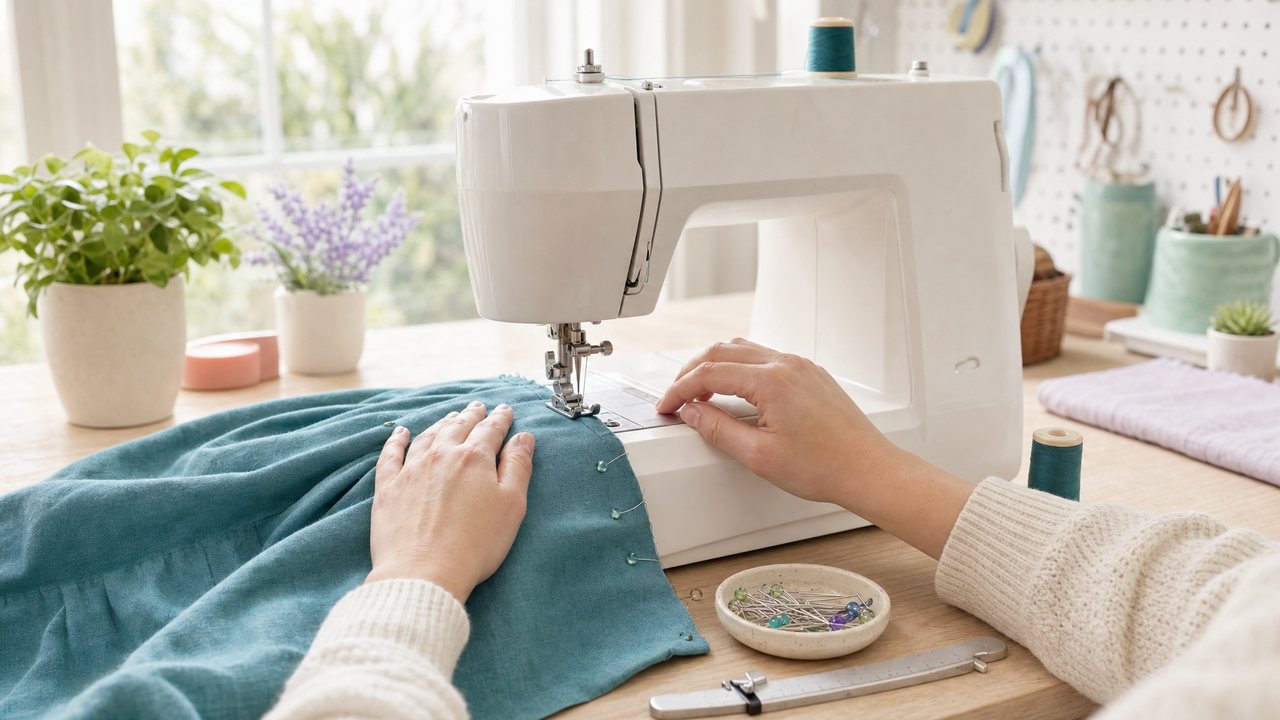
Just do: set a straight stitch of about 2.5 mm, use the seam allowance your pattern gives (often 5/8 inch or 1.5 cm), and backstitch at the start and end. Finish raw edges with a zigzag stitch so they do not fray. For the casing, fold the top edge down, stitch, leave a gap, and thread 1 inch (2.5 cm) wide elastic through with a safety pin.
Ask Wren:
- "What thread in my stash would suit this fabric?"
- "My test seam looks puckered. What should I try first?"
Wren cannot see inside your machine or change its settings. It can suggest what to check (stitch length, needle, tension), and you test each change on the scrap. If something goes wrong, how to fix common sewing mistakes with live help covers puckers, skipped stitches and more.
Stage 6 and 7: How do you press and hem?
Press every seam as you go, then fold the hem twice, press it, and stitch close to the inner fold. Pressing is what makes a first garment look finished.
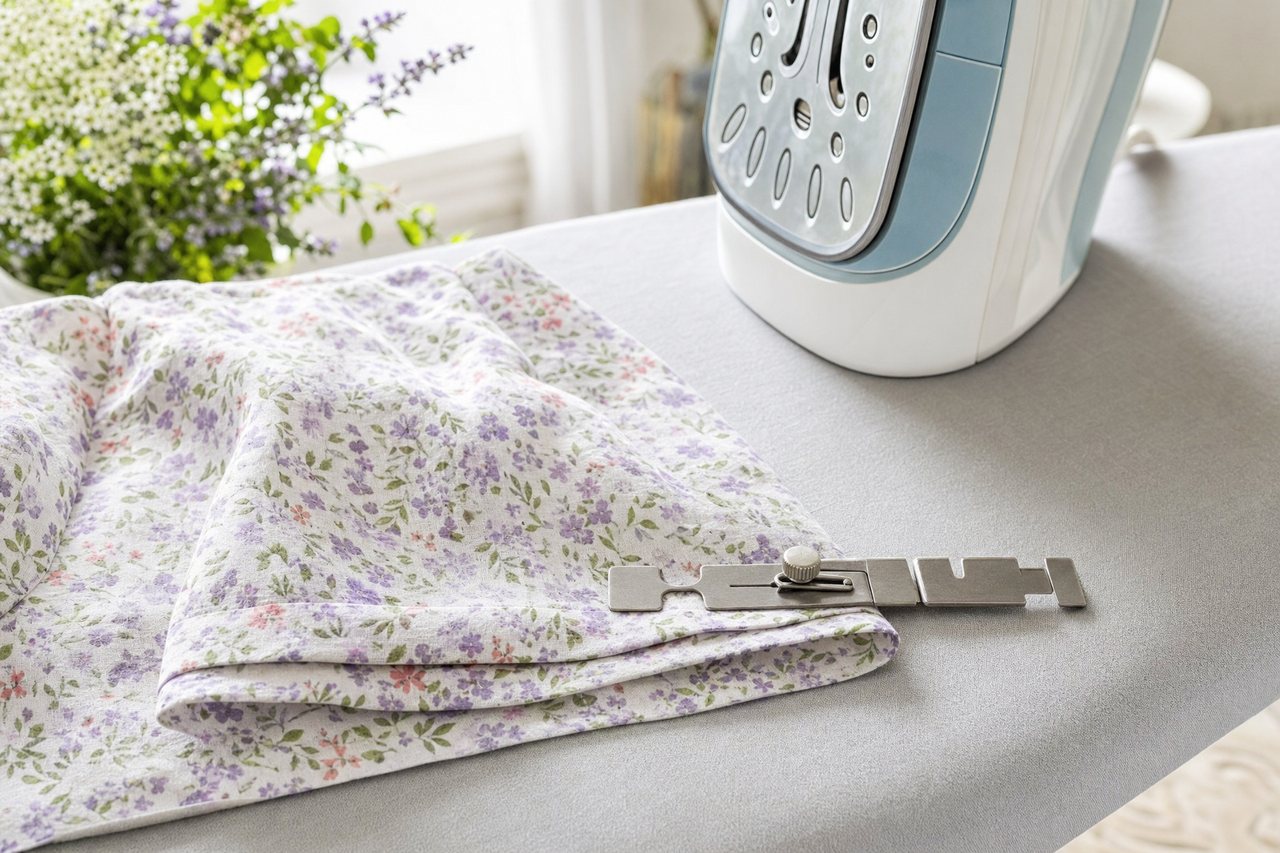
Just do: press each seam flat, then open or to one side, as your pattern says. For a double-fold hem, fold up about 1/2 inch (1.3 cm), press, fold again by 1 inch (2.5 cm), press, pin and stitch. Use a seam gauge so the fold stays even.
Ask Wren: "How deep should my hem be for this length?" or "My hem looks wavy. Why?" Hold the hem up to the camera so it can see.
A beginner checklist for the last stage:
- All seams pressed
- Raw edges finished
- Elastic evened out and stitched closed
- Hem pressed before stitching
- Loose threads trimmed
Try it
Pick your first pattern and one stable cotton from your stash, set them as your current project, and write down your two biggest questions. Then start a call with Wren for beginner sewing help. For more on what to show the camera, read 12 questions to ask an AI sewing coach about your fabric, and for every other AI tool, see the complete guide to AI sewing tools. Your first call is free with a free account, and Pro includes unlimited calls for $4.99 a month or $47.88 a year after a 14-day free trial.